
Tezz vs Other Frameworks
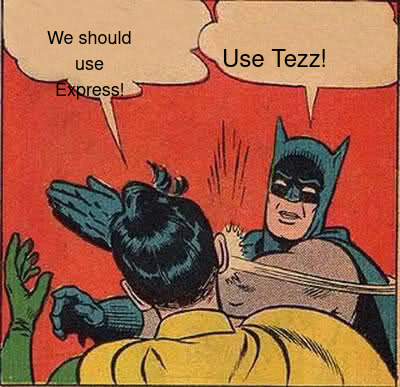
Tezz is designed to bring the speed of compiled languages with the ease of JavaScript and Python. Here is how Tezz compares with other popular backend ecosystems.
Node.js (Express / Fastify)
While Tezz compiles to JavaScript (for Cloudflare Workers or Node environments), the source language eliminates the boilerplate of Express.js.
- Setup: Node requires
package.json, npm installs, and complex setups. Tezz is zero-config. - Routing: Tezz has built-in declarative routing via the
serviceblock. - Speed: Tezz compiles directly into native Fetch API / Worker formats, bypassing heavy middleware layers.
Python (FastAPI / Django)
Python is loved for its simplicity, but it struggles with asynchronous performance and deployment complexity (WSGI/ASGI).
- Syntax: Tezz offers a Python-like clean syntax but adds strict safety.
- Performance: Tezz is significantly faster than Python because it compiles to V8 optimized JavaScript rather than interpreted Python bytecode.
- Deployment: Deploying Python requires Gunicorn/Uvicorn and Docker. Tezz deploys to edge networks (Cloudflare) in 1 second.
Go (Golang)
Go is the king of backend performance and concurrency. Tezz aims to be the "Go for the Edge".
- Learning Curve: Go requires understanding pointers, goroutines, and strict typing. Tezz is as easy to learn as JavaScript.
- Cold Starts: Go binaries can be large. Tezz compiles to tiny JS bundles with 0ms cold starts on the Edge.
- Ecosystem: Go has a rich standard library. Tezz relies on the massive npm ecosystem under the hood.
Rust (Actix / Axum)
Rust offers unparalleled memory safety and speed, but at the cost of a notoriously steep learning curve.
- Development Speed: Writing a Rust backend takes time due to the borrow checker. Tezz lets you prototype and ship in minutes.
- Safety: Rust guarantees memory safety at compile time. Tezz relies on the V8 engine's garbage collector.
- Use Case: Use Rust for OS-level systems and CPU-heavy tasks. Use Tezz for blazing fast web APIs and microservices.